Saturday, May 4, 2019

Classwork WMSIO #6

Read pages 173-176
Answer questions # 1, 3, 4, 5 on page 176.
Complete worksheet 4 (page 91).

Notes:

  • End of the reign of emperor Marcus Aurelius (AD 161-180) marked the end of Pax Romana.
    • Following rulers did not know how to manage such a vast empire and it, in return, started declining.
  • During third century AD, Rome's economy weakened due to several factors.
    • Hostile tribes outside boundaries of the empire and other pirates from the Mediterranean Sea disrupted trade.
    • Having reached limit of expansion, Romans were in need of more precious metal.
      • The government raised taxes, desperate for revenue.
        • Also started minting coins that contained less and less silver.
          • With the hope of creating more money with the same amount of precious metal it would take to make less.
        • The economy soon suffered from inflation.
    • Harvests in Italy and western Europe became increasingly meager because the overworked soil had lost its fertility.
      • Years of war had also destroyed much farmland.
    • Eventually, serious food shortages and disease spread, and the population declined.
  • Military and Political Turmoil
    • Over time, Roman soldiers had become less disciplined and loyal.
      • Gave their allegiance to their commanders, who fought amongst themselves for the throne, instead of Rome.
    • To defend against increasing threats to the empire, the government began recruiting mercenaries.
    • Eventually, citizens' feelings of loyalty also declined, losing their sense of patriotism.
  • Diocletian (r. AD 284-305)
    • Strong-willed army leader who became the new emperor.
    • Severely limited personal freedoms.
    • Doubled the size of the army and attempted to control the inflation by setting fixed prices for goods.
    • Believed the empire had grown too vast for one lone ruler.
      • Divided the empire into 
        • Greek-speaking East (Greece, Anatolia, Syria, and Egypt).
        • Latin-speaking West (Italy, Gaul, Britain, and Spain).
      • Kept the eastern half for himself and appointed a co-ruler for the West.
    • Even though he shared authority, he kept overall control.
      • His eastern part of the empire was far wealthier than the western part of the empire, for it included most of the empire's great cities and trade centers.
    • Retired due to ill health.
  • Diocletian's plans for orderly succession failed and civil war broke out.
    • By AD 311, four rivals were competing for power.
      • One of them was Constantine, the one who would later end the persecution of Christians.
  • Constantine gained control of the western part by AD 312 and continued many of the social and economic policies of Diocletian.
    • By 324, united both parts of the empire.


1. For each term or name, write a sentence explaining its significance.
Inflation: A drastic drop in the value of money coupled with a rise in prices.
Mercenary: Foreign soldier who fought in exchange for money.
Diocletian: A strong-willed army leader.
Constantinople: (9Modern day Turkey) city of Constantine, previously called Byzantium.
Attila: Powerful chieftain of the Huns who terrorized  both halves of the Roman empire with his 100,000 men.

3. What were the main internal causes of the empire's decline? The government raised taxes to meet revenue when precious metals were scarce and the economy soon suffered from inflation; harvests were  becoming increasingly meager due to the overworked soil; food shortages and disease spread; soldiers had become less disciplined and loyal; and citizens were becoming less and less patriotic and would refuse to fight for their country.

4. How did Diocletian succeed in preserving the empire? He doubled the size of the Roman army; controlled inflation by setting fixed prices on goods; presented himself in god-like aura to restore the prestige of the office of emperor; and divided the Roman empire into the Greek-speaking East and the Latin-speaking West.

5. Why did so many Germanic tribes begin invading the Roman Empire? Due to the Asian nomadic tribe known as the Huns burning everything in their path (starting with Germanic tribes living near the borders of the empire), the Germanic tribes had to choice but to go inland.


P.S. I did Day 6's classwork because the board stated to read the pages from day 6. I did not check on the piece of paper nor online because I thought it was correct. By the time I realized I was not, it was too late, so I decided to stick with it.

Thursday, May 2, 2019

Classwork WMSIO #4

Review the rap and the PowerPoint.
Write a paragraph comparing rap info with paragraph info.


The book did not say anything about the swamp (which I think means that the government is corrupt), or I at least don't remember reading so. There are three branches of government (and only one government) in the book, but three governments in the rap: democracy, aristocracy, and monarchy, which I think cannot be possible, made into a republic. The rap did have that it was not a tyranny and the book didn't specify it, but it sure did not say that it was a tyranny. Instead, the book stated the government as a republic. Plebeians were not having fun because they were being oppressed by patricians; they were definitely having some fun. Both the textbook and the rap state there are two consuls and all the army terms. Both go over the Punic Wars and Hannibal's strategy of going though the Alps. The rap did not go over the Punic Wars in much detail, a thing that the book did do. In the book, there were three wars between Carthage and Rome going from 264 BC - 146 BC. 

The rap did not give the backstory of why the rich were getting richer and what the latifundia was, but the book did. Both talked about the Gracchus brothers were killed by senators and how it started a civil war. Then, Julius Caesar started rising around 60 BC and formed a triumvirate (group of three leaders) with Pompey and Crassus. Then, Julius Caesar conquered Gaul and gained his troops' devotion; that is in both the book and the rap. The battle between Pompey and Julius Caesar after crossing the Rubicon River was covered. The rap kind of went over Julius C. becoming a dictator if one reads in between lines, and the book specified so. March 15, 44 BC was the death of Julius C. He died of 23 stab wounds and his last words were "Et tu, Brute?" 

At 18 years old, Octavian formed a new triumvirate with Lepidus and Mark Antony. Mark Antony met Cleopatra and became allies against Octavian. He won against them and accepted the title of Augustus. Pax Romana started in 27 BC for 207 years. Slaves didn't have many rights. For entertainment, Romans watched gladiator fighting. (There is no Circus Maximus in the textbook.)

To be such a short rap, it covers most of the important parts and is very well done.

Tuesday, April 30, 2019

Classwork WMSIO #3

Notes:


1. For each term or name, write a sentence explaining its significance.


Civil War: Conflict between opposing groups within the same country.

Julius Caesar: Military leader involved in the first ever triumvirate in Rome. In 44 BC, he was named dictator for life and was then killed on March 15, 44 BC.

Triumvirate: A group of three rulers.

Augustus: Title given to a ruler, which means "exalted one".

Pax Romana: "Roman peace"--a period of peace and prosperity lasting 207 years (27 BC - AD 180) after the start of Augustus' ruling.


3. What factors contributed to the fall of the Roman Republic? The growing discontent among lower classes in society and a breakdown in military order. Brothers Tiberius and Gaius Gracchus attempted to make the poor content. Following their death, a civil war took place in Rome. As the republic became more unstable, military generals seized power for themselves.


4. What were the main reasons for the Romans' success in controlling such a large empire? Efficient government and able leaders. For example, Augustus glorified Rome and also set up civil service. That is, he paid officers to manage people's affairs.


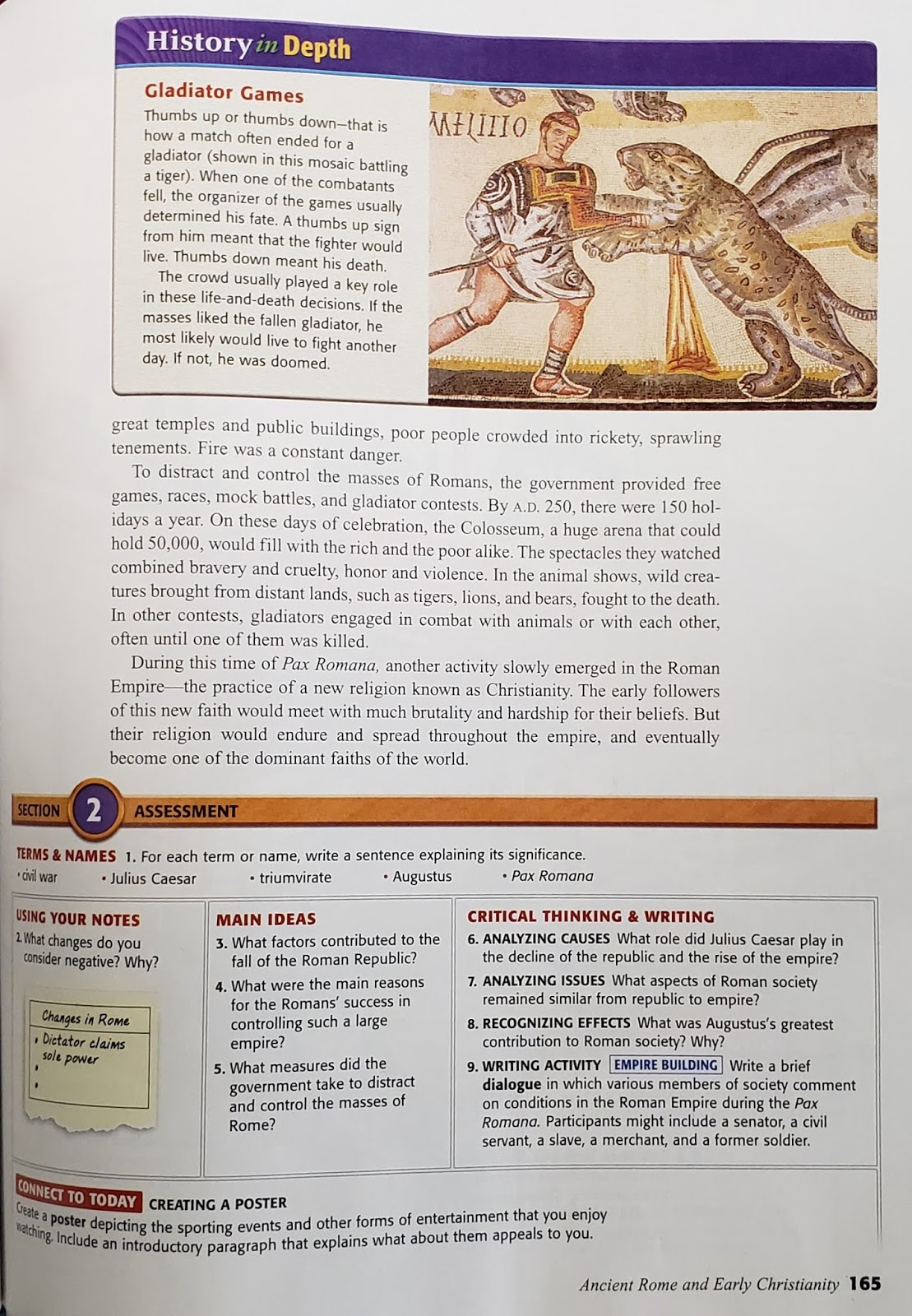
5. What measures did the government take to distract and control the masses of Rome? It provided free games, races, mock battles, and gladiator fights. By AD 250, Romans already celebrated 150 holidays in the Colosseum.

Monday, April 29, 2019

Classwork WMSIO #2

finish reading The Roman Republic (p. 155-159)
answer questions 1, 3, 4, 5 (p. 159)
do worksheet 1 (The Romans Create a Republic p.88)


Notes:


  • By the fourth century BC, the Romans dominated central Italy, and by 265 BC, they were the masters of nearly all of Italy.
  • Punic Wars (264 - 146 BC) were between Rome and Carthage, a colony of Phoenicia.
    • First Punic War  (264 - 241 BC)
      • Fought in the western Mediterranean for control of Sicily.
      • Ended in the defeat of Carthage.
    • Second Punic War (218 - 202 BC)
      • Mastermind behind the war was 29-year-old Carthaginian general named Hannibal.
      • Hannibal assembled an army of 50,000 infantry, 9,000 cavalry, and 60 elephants.
        • For more than a decade, moved his army on a long trek from Spain across France and through the Alps.
          • Lost half his men and most of his elephants.
        • Won his greatest victory at Cannae in 216 BC.
          • With the aid of many allies, the Romans prevented capturing of Rome.
      • Finally, the Romans found a military leader to match Hannibal's boldness--Scipio.
        • In 202 BC, Hannibal was forced to defend his native city, Zama, and was defeated by the Romans.
    • Third Punic War (149 - 146 BC)
      • After Rome laid siege to Carthage, the city was set afire on 146 BC and its 50,000 inhabitants were sold as slaves.

  • By winning the Punic Wars, Rome gained dominance over the western Mediterranean.
    • Then went on to conquer the eastern half.
      • By 70 BC, Rome's Mediterranean empire stretched from Anatolia to Spain.


Questions:


1. For each term or name, write a sentence explaining its significance.

Republic: (comes from the Latin res publica, "people's affairs") people choose representative to vote in behalf of the people.

Patrician: wealthy, aristocratic landowners who held most of the power in the early republic.

Plebeian: common farmers, merchants, workers, and artisans which made up the majority of the Roman citizens.

Tribune: someone elected to represent the Roman lower class citizens.

Consul: One of two officials who shared the powers of ruling the republic  and whose time in office was limited to only a year. (They also could not be re-elected before ten years after their previous term.)

Senate: assembly composed of upper class citizens only.

Dictator: Someone with absolute power who only led the people for six months.

Legion: Military division of the Roman army.

Punic Wars: Three battles lasting over a century between Rome and Carthage.

Hannibal: Led a force of 50,000 soldiers and 60 elephants through the Alps for more than a decade to attemmpt to conquer Italy.


3. What limits were there on the power of the Roman consuls? They both had the power to overpower each other; so they limited each other's power. Their terms were a year's length and could not be elected again in ten years.


4. What was the significance of the Twelve Tables? The upper class people would stop inventing more ways to punish poor people. It gave lower class citizens rights and defended them from unjust laws created against them.


5. How was Hannibal's attack on Rome daring and different? He decided to lead his troops through the Alps to attack Romans head on.

Friday, April 26, 2019

Classwork WMSIO #1

What to do:
Write out main ideas from pages 152 and 153.
Write out timeline (only for Rome).
Start reading pages 155 through 159.


Ancient Rome and Early Christianity (500 BC-AD 500)


Main Ideas:


Power and Authority - Rome began as a republic, a government in which elected officials represent the people. But, eventually, absolute rulers (emperors) seized power and expanded the empire.

Empire Building - At its height, the Roman Empire touched three continents--Europe, Asia, and Africa. For several countries, Rome brought peace and prosperity to its empire before its eventual collapse.

Religious and Ethical Systems - Out of Judea rose a monotheistic (single-god) religion called Christianity. Based on the teachings of Jesus of Nazareth, it soon spread throughout Rome and beyond.


Timeline:


509 BC
Rome becomes a republic.

264 BC
First Punic War begins.

218 BC
In the Second Punic War, Hannibal invades Italy.

31 BC
Octavian defeats the forces of Antony and Cleopatra.

AD 284
Diocletian becomes emperor of Rome.

AD 476
Western Roman Empire falls.


Notes:


  •  Rome founded 753 BC by Romulus and Remus according to the legend.
    •  Built on seven rolling hills near midpoint of the Mediterranean Sea.
    • Earliest inhabitants, Greeks, Latins, and Etruscans, came in around 1000 BC and 500 BC.
      • Latins built the original settlement at Rome on the Palatine Hill, and were therefore believed to be the first Romans.
      • Between 750 BC and 600 BC, the Greeks established colonies along Southern Italy and Sicily.
      • Etruscans (skilled metalworkers and artisans) are native to Northern Italy.
        • They influenced Romans' architecture (using the arch) and their writing system.
    • Around 600 BC, an Etruscan became the king of Rome.
      • (Popular public center Forum was the heart of Roman political life.) 
      • The last king was Tarquin the Proud (Superbus).
        • Driven from power in 509 BC due to tyranny in both senses of the word.
    • Established a republican government from the phrase res publica, meaning "public affairs."
      • A republic is a form of government in which citizens vote for their leaders. (Only free-born male citizens were given the right to vote.)

  • Struggle for power.
    • Patricians--wealthy landowners--versus plebeians--common farmers, artisans, and merchants, which are the majority of the population.
    • Tribunes--assembly formed by plebeians that chose representatives for themselves.
      • Protect rights of plebeians from unfair acts of patrician officials.
    • The Twelve Tables
      • On 451 BC, ten patrician officials wrote down Rome's notes.
      • Carved on twelve tables and hanged in the Forum.
  • Government terms.
    • Legal code in: 
      • Rome was the Twelve Tables
      • the United States is the United States Constitution.
    • Consul: king-like leader who commanded the army and directed the government. The consuls worked in pairs and composed the executive branch of the government.
    • Senate: had 300 aristocrats who took care of domestic policies. Its counterpart at the time would have been the Tribal Assembly, which was elected by the tribune and made laws for the common people.

Wednesday, April 24, 2019

April 24, 2019 Class

I have set my mind to memorizing the Rome song. Apparently, some kids have used it to memorize the test answers and I will surely do that. Also, the song link didn't work for me. And in case it also didn't work for you, I'm putting a link I found on YouTube here. Also, I found an amazing video of the Greco Persian Wars that you guys should totally watch. He is apparently still in John Carroll and I honestly congrat him from this blog. (P.S. I will definitely ask around juniors I know to find him.)

Who settled Rome? (Firstly, Latins.)
  • Located along Tiber river
  • Etruscans.
    • Came from north-central part of the peninsula.
    • Had metalworkers, artists, and architects.
    • Two foundating myths:
      • Virgil's Aeneid (very close to the Odyssey).
      • Brothers Remus and Romulus raised by she-wolf.

Tuesday, April 23, 2019

April 23, 2019 Class

Mr. Schick is suffering from umbilical hernia and has got to undergo surgery. At six o'clock in the morning (0600) on Thursday, Mr. Schick will start going into surgery and will miss ten days of school (otherwise stated as two weeks resting overall). We will miss him greatly and will remember him as we work each of the eight assigned days. We will have him present in class tomorrow, April 24, 2019 for "LOOK FORWARD," whatever it is. I checked my blog entries and found out my blog was visited twenty-one times from Germany. Amazing! Also, I have another new place to add--Indonesia. Now, I have people that visit my blog from Egypt, Indonesia, Germany, (an) unknown location(s), and a familiar from the Dominican Republic.